


When and How to Replace a Bicycle Chain: Wear, Measurement, and Tips

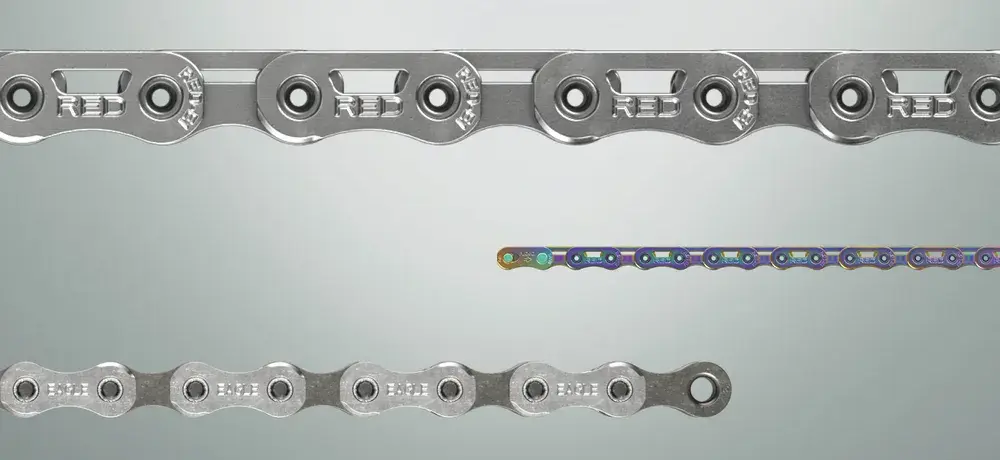
A chain should be replaced based not on “mileage,” but on wear — this will help protect your cassette and chainrings.
When to Replace It
The best criterion is chain wear (elongation):
0.5% — time to replace it on 10–12-speed chains (and in general, it is better not to wait too long).
0.75% — the limit for 8–9-speed chains (and for 10-speed, this is often already too late).
1.0% — usually means you are already starting to wear out the cassette/chainrings (and often you will need to replace more than just the chain).
Signs That It’s “Too Late” (Even Without a Measuring Tool)
The chain slips/skips under load (especially in the most frequently used gears).
The cassette teeth have developed a “shark fin” shape (sharp, slanted profile).
When you install a new chain, it skips on the old cassette → this means the cassette is already worn to match the old chain.
How to Check Wear
Option 1 — Chain Checker
Insert the chain checker — if it “drops in” at 0.5/0.75, use the number of speeds as your guide (see above).
Option 2 — Ruler (more accurate, but slower)
Align 0 mm with the center point of any pin.
On a new chain, 12” = 304.8 mm (that is 12 full links).
If over 12 links you get approximately:
+1.5 mm ≈ 0.5% (replace for 10–12-speed drivetrains)
+2.3 mm ≈ 0.75% (replace for 8–9-speed drivetrains)
+3.0 mm ≈ 1.0% (already too late)
How Often (Very Roughly)
It depends on dirt, lubrication, riding style, and power:
Road, dry: often 2000–5000 km
City / all-weather riding: 1000–3000 km
MTB / mud / winter: sometimes 500–1500 km
How to Extend Service Life
Clean it regularly (especially after rain/mud).
Lubricate according to conditions: wet for moisture, dry for dry/dusty conditions.
Do not pour it on “like engine oil”: one drop on each roller, then wipe off the excess.
Pay attention to the chain line and avoid riding for long periods in a heavily cross-chained gear combination.
If you tell me how many speeds you have (for example 9/10/11/12), your bike type (MTB/road/city), and the conditions you ride in (dry/mud/winter), I can suggest your ideal “replacement threshold” and how often you should check the chain.


